Former military and intelligence officials have become important voices in the UAP debate. Some describe firsthand encounters, while others say they learned about secret programs through their government work.
David Grusch, a former Air Force and intelligence officer, brought renewed attention to the subject in 2023. He alleged that the U.S. government and private contractors had concealed a decades-long program involving the recovery and attempted reverse engineering of craft of unknown origin.
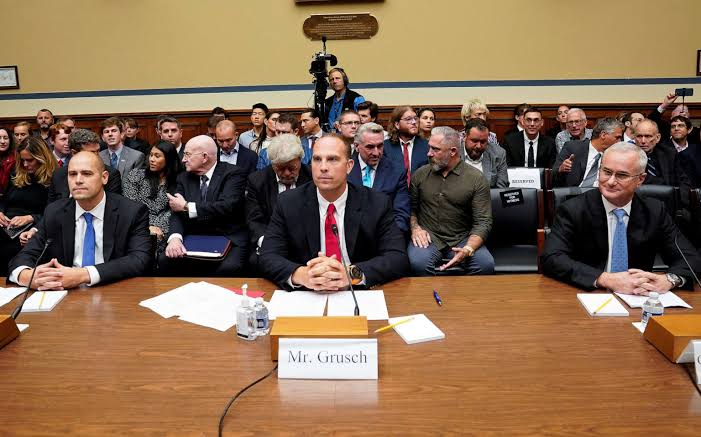
During a July 2023 congressional hearing, Grusch testified under oath that his investigation included interviews with roughly 40 witnesses over four years. He also said people with direct knowledge had told him that “nonhuman biologics” were recovered with some craft. Grusch acknowledged that much of his public testimony was based on information provided by others, although he said he gave classified details—including names and locations—to inspectors general and members of Congress.
The Pentagon’s All-domain Anomaly Resolution Office reached a different conclusion in its March 2024 historical review. AARO said it found no verifiable evidence that the U.S. government or private companies had recovered extraterrestrial technology. It also concluded that some alleged secret programs had been misidentified or involved unrelated national-security work. Critics questioned whether AARO had access to every relevant witness and compartmented program, leaving the dispute unresolved.
Grusch continued speaking publicly about the issue. In May 2026, he repeated his allegations during a lengthy interview and argued that secrecy, restricted access, and weak whistleblower protections were preventing proper oversight. He did not release physical evidence or classified records to support the claims.
On June 9, 2026, Grusch returned to Capitol Hill for a press conference with a bipartisan group of lawmakers. He called for stronger whistleblower protections, passage of broader UAP disclosure legislation, and the release of additional government records. He also repeated his claim that UAP-related programs and spending had been hidden from Congress. The event renewed political pressure for disclosure but did not produce publicly verifiable evidence of recovered craft or nonhuman remains.
Retired Army Colonel Karl Nell, who worked with Grusch on the UAP Task Force, has publicly supported the central allegation that technology of unknown origin was recovered and studied. Nell was not the director of AARO, however, and several more extraordinary statements previously attributed to him—including claims about time travel, secret societies, and a hidden plan for humanity—cannot be verified in the cited reporting.
Former Navy pilots David Fravor and Ryan Graves also testified before Congress in 2023. Fravor described his 2004 encounter with the “Tic Tac” object near the USS Nimitz. Graves said UAP sightings became common during training exercises off the East Coast and raised serious aviation-safety concerns.
Grusch’s allegations helped move UAP from the political fringe into congressional debate. They have encouraged hearings, proposed legislation, classified briefings, and demands for greater transparency. But the central question remains unanswered: no recovered craft, biological material, or independently verified documentation proving his claims has been made public.
Sources: Grusch’s prepared congressional statement, AARO’s 2024 historical report, and Reuters documentation of the June 2026 Capitol Hill event.
```