
GOVERNMENT FILE WATCH // SEPTEMBER 10, 2026
Two AARO releases, DOW-UAP-PR076 and DOW-UAP-PR077, illustrate a recurring problem in public UAP analysis: a video can be authentic as a government-held file while still lacking enough provenance and telemetry to support strong performance claims.
PR076: a long file with a short visible segment
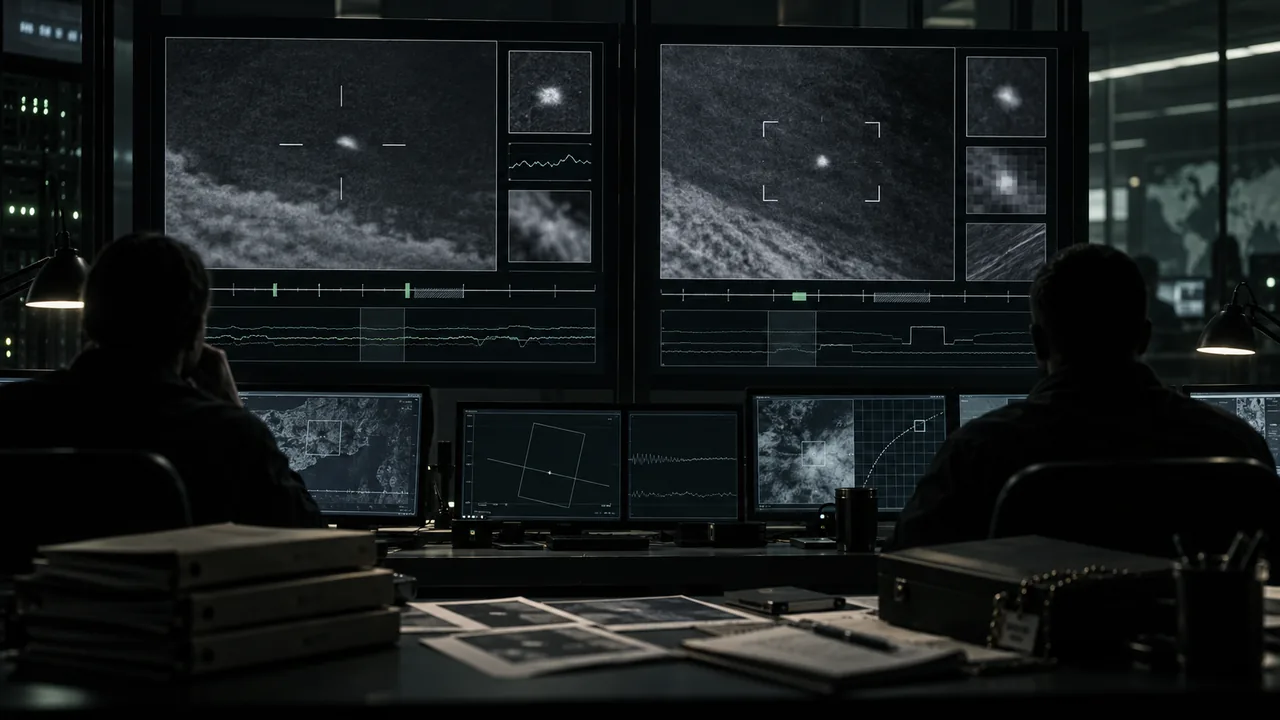
DVIDS lists PR076 as a four-minute, fifty-seven-second video associated with January 3, 2021. AARO says it is likely derived from an infrared sensor aboard a U.S. military platform in the U.S. Central Command area. According to the official description, the first one minute and fifty-one seconds contain no relevant content. An area of contrast then appears, the sensor pans to keep it near the center and later zooms before the contrast leaves the display. The remainder contains no relevant content.
That description establishes a timeline of screen events. It does not establish range, size, speed or acceleration. When a sensor pans and zooms, apparent motion in the frame combines target motion, platform motion and camera pointing. Without platform state and line-of-sight data, analysts cannot reliably separate those components.
PR077: similar subject matter is not duplication
DVIDS lists PR077 as a four-minute, fifty-eight-second recording dated November 2, 2020. AARO specifically notes that PR077 and PR078 are distinct files despite depicting highly similar subject matter. That clarification is valuable because visually similar releases can be mistakenly collapsed into one event or counted as independent confirmation without checking dates, identifiers and source records.
The public PR077 page links the file to the same congressional request context while warning that the description is not an analytical judgment about the event's validity, nature or significance. The government-hosted file is primary-source media; its unresolved appearance is not a physical classification.
The chain-of-custody warning controls the conclusion
AARO says it found responsive material on a classified network and that many files lack a substantiated chain of custody. That can mean the public package does not fully establish who recorded the imagery, which exact sensor produced it, whether it was exported or re-encoded, or whether metadata remained attached. Provenance gaps do not make the pixels meaningless, but they limit what those pixels can prove.
What would enable a stronger assessment
- Native sensor frames rather than a display recording or recompressed copy.
- Platform position, altitude, speed, attitude and sensor pointing angles.
- Range or a defensible range estimate.
- Original timestamps and export history.
- Weather, air-traffic and mission context.
- An event-level chain-of-custody record linking the public file to the recording system.
Until those elements are released, the disciplined conclusion is narrow: PR076 and PR077 are government-published infrared records containing areas of contrast that operators tracked. The public files do not independently establish extraordinary speed, size, maneuverability or origin.