Search an independent index of records released through the government's Presidential Unsealing and Reporting System for UAP Encounters. Original government files remain the authoritative source.
134 OFFICIAL INCIDENT RECORDS / RELEASES 01–06
UAP video incident library
Browse official incident metadata and verified playable video matches from PURSUE Releases 01–06.
Filter the evidence first, then zoom and drag the map in any direction. Blue markers are specifically or approximately located; orange markers represent broader regions.
1.0×
Choose a country or zoom in
Specific / approximateRegional placement32 mapped incident groups
Map positions may represent a broad region rather than an exact coordinate. Redacted or genuinely unknown locations remain searchable but are not plotted.
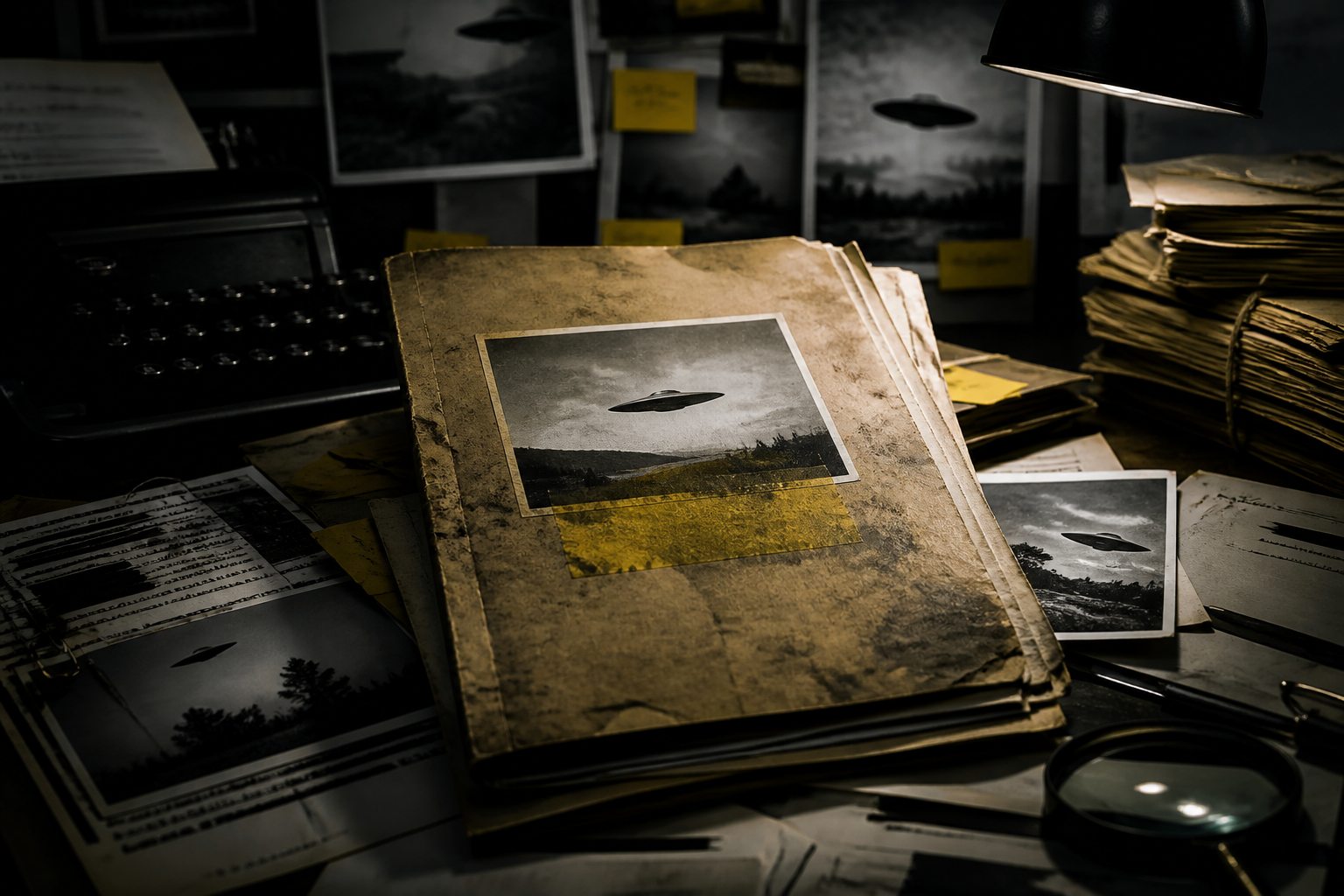
Project Blue Book File on Tremonton Film, Utah, 1952
The Blue Book case file brings together investigation of Delbert Newhouse’s July 1952 Tremonton film and later assessments of what it showed. It records his photography experience, reported observation of a group of reflective objects, and the Air Force’s changing interpretation. Read it alongside the film, photo file, and personnel record to separate witness testimony from subsequent analysis.
The July 2008 Statement of Objectives sets out AAWSAP’s proposed research into long-term foreign aerospace threats, looking toward 2050. It lists twelve technical areas and requires progress reports, management plans, technical briefings, and an integrated assessment. It documents the program’s commissioned scope, not demonstrated breakthrough technology.
AAWSAP Solicitation and Original Order, September 2008
The September 2008 solicitation and original award turn AAWSAP’s research objectives into a contract with Bigelow Aerospace Advanced Space Studies. The record helps trace the administrative origin of the program and the work commissioned from its contractor.
AAWSAP DIRD, Metallic Glasses for Aerospace Applications, December 2009
Reviews amorphous metallic alloys as aerospace materials. It weighs strength and manufacturing advantages against brittleness and fatigue, identifying composites and improved lightweight alloys as more promising routes than using single-phase metallic glasses alone. This AAWSAP Defense Intelligence Reference Document is a historical technical review. Its inclusion in PURSUE does not validate the proposed technologies or link them to a particular UAP encounter.
Surveys electronics that use electron spin as well as charge. Giant magnetoresistance and spin-transfer torque are considered for memory, sensing, and logic, with advanced applications still dependent on further development. This AAWSAP Defense Intelligence Reference Document is a historical technical review. Its inclusion in PURSUE does not validate the proposed technologies or link them to a particular UAP encounter.
Transcript of a Presentation by Captain Edward J. Ruppelt, 1952
A transcript of Edward Ruppelt’s March 1952 presentation describes the Air Force’s approach to UFO investigation, unresolved reports, and proposed improvements to photography and radar collection. It preserves the program’s contemporary thinking and is paired with the audio presentation.
Digitized footage of Delbert Newhouse’s July 2, 1952 observation near Tremonton, Utah. The film became a Blue Book case. Compare it with D102–D105 and the earlier film analysis D098; bright moving points alone do not settle the objects’ identity.
A transcript of Edward Ruppelt’s March 1952 presentation describes the Air Force’s approach to UFO investigation, unresolved reports, and proposed improvements to photography and radar collection. It preserves the program’s contemporary thinking and is paired with the audio presentation.
A 79-second cellphone recording submitted by a Colorado law-enforcement officer, associated with transcript LLE-UAP-D001. The officer reported a silent light with changing colors. The release includes privacy-related edits; the reported appearance does not resolve the source of the light.
A 15-minute cellphone recording submitted by a Colorado law-enforcement officer, associated with transcript LLE-UAP-D002. The officer reported a silent light with changing colors. The release includes privacy-related edits; the reported appearance does not resolve the source of the light.
Project Blue Book Photo File Relating to Tremonton Film, Utah, 1952
The photographic companion to the Tremonton investigation preserves imagery associated with the July 1952 Utah film. It supplies visual context for the Blue Book case file; still frames alone do not establish the objects’ size, distance, or identity.
Final Personnel Record for Newhouse, Delbert C., U.S. Navy, 1957
This Navy personnel file documents Delbert Newhouse’s service and photographic work. Newhouse filmed the 1952 Tremonton sighting. The record helps establish the witness’s professional background; it is not an independent identification of the objects in the film.
An Air Force intelligence collection covering flying-disc reporting from September through December 1952. It combines correspondence, reporting forms, case material, and administrative records from multiple sources, including material on Tremonton. It should be read as a collection of reports and official responses rather than a single finding.
A 2022 military mission report from Iraq supplies operational context for the infrared still images PR130 and PR131. The operator described irregular movement and estimated speeds. Those estimates are part of the witness report and cannot be independently recovered from the still images alone.
A military mission report from the Middle East in 2025 accompanies infrared video PR133. An operator described a bright, round object and estimated its speed. The report adds the operator’s account to the sensor footage; neither the description nor the speed estimate is a resolved identification.
A 2025 Middle East mission report accompanies video PR135. The operator reported several small spherical objects moving together and changing direction. Its numerical estimates and visual descriptions reflect the report made at the time and require the original sensor geometry for independent evaluation.
This 2022 Middle East mission report is associated with PR140 and PR141. It provides the military operator’s account and estimated movement alongside the electro-optical and infrared recordings. Compare the written report with both sensor views before drawing conclusions about speed or physical characteristics.
AAWSAP Contract Modification P00001, September 2009
Contract modification P00001 changes AAWSAP’s performance dates and exercises an option year subject to funding availability. It is part of the administrative trail needed to understand the duration of the BAASS research contract.
AAWSAP Contract Modification P00002, February 2010
Contract modification P00002 provides funding for AAWSAP’s first option year and removes the earlier funding contingency. It concerns the contract’s financial and delivery arrangements rather than a new sighting or experimental result.
Modification P00003 records a May 2010 change to the AAWSAP contract. Read it with the original award and other modifications to follow the program’s contractual history; a contracting action does not establish that the concepts under study were achieved.
Modification P00004 is a further May 2010 administrative record in AAWSAP’s contracting history. It belongs with the statement of objectives, award, and other changes as evidence of how the research effort was managed.
AAWSAP Contract Modification P00005, September 2010
Modification P00005 records a September 2010 change to the AAWSAP contract. It provides a later point in the program’s administrative record and should be compared with the original order and preceding modifications.
AAWSAP DIRD, Aerospace Applications of Programmable Matter, December 2009
Explores materials whose behavior or function could be reconfigured electronically. Proposed uses include adaptable surfaces, sensors, thermal control, and camouflage, while fabrication, reliability, radiation, and control security remain major obstacles. This AAWSAP Defense Intelligence Reference Document is a historical technical review. Its inclusion in PURSUE does not validate the proposed technologies or link them to a particular UAP encounter.
Surveys materials used in implants, medical sensors, drug delivery, and other systems that interact with living tissue. The emphasis is on matching material properties to a particular use, with biocompatibility, reliability, and safety testing limiting rapid adoption. This AAWSAP Defense Intelligence Reference Document is a historical technical review. Its inclusion in PURSUE does not validate the proposed technologies or link them to a particular UAP encounter.
AAWSAP DIRD, Materials for Advanced Aerospace Platforms, January 2010
Compares advanced metals, ceramics, and composites for aerospace structures and propulsion. Material selection is treated as a design tradeoff involving temperature, weight, durability, manufacturing, inspection, and cost. This AAWSAP Defense Intelligence Reference Document is a historical technical review. Its inclusion in PURSUE does not validate the proposed technologies or link them to a particular UAP encounter.
AAWSAP DIRD, Pulsed High-Power Microwave Source Technology, January 2010
Reviews high-power microwave source technology and the engineering constraints on compact systems. It discusses the dependence on pulse power, switching, insulation, antennas, and thermal management at a survey level. This AAWSAP Defense Intelligence Reference Document is a historical technical review. Its inclusion in PURSUE does not validate the proposed technologies or link them to a particular UAP encounter.
AAWSAP DIRD, Invisibility Cloaking Theory and Experiments, March 2010
Examines camouflage, transformation optics, and metamaterial approaches to cloaking. Limited microwave demonstrations are distinguished from the much harder problem of broad or visible-light invisibility; the report does not document an invisible aircraft. This AAWSAP Defense Intelligence Reference Document is a historical technical review. Its inclusion in PURSUE does not validate the proposed technologies or link them to a particular UAP encounter.
AAWSAP DIRD, Positron Aerospace Propulsion, March 2010
Considers positrons as a high-energy propulsion resource. The proposed aerospace applications depend on producing and storing antimatter at useful scales, capabilities the report treats as unresolved. This AAWSAP Defense Intelligence Reference Document is a historical technical review. Its inclusion in PURSUE does not validate the proposed technologies or link them to a particular UAP encounter.
AAWSAP DIRD, Space Access: Where We’ve Been and Where We Could Go, March 2010
Examines the history and future of access to orbit, emphasizing reusable transport and supporting infrastructure. It argues for reliable, repeatable space operations rather than treating each launch as an isolated vehicle-design problem. This AAWSAP Defense Intelligence Reference Document is a historical technical review. Its inclusion in PURSUE does not validate the proposed technologies or link them to a particular UAP encounter.
AAWSAP DIRD, Inertial Electrostatic Confinement Fusion, March 2010
Reviews inertial electrostatic confinement fusion, including its experimental status and possible radiation-source applications. It distinguishes such nearer-term uses from the unresolved challenge of net-energy fusion and practical propulsion. This AAWSAP Defense Intelligence Reference Document is a historical technical review. Its inclusion in PURSUE does not validate the proposed technologies or link them to a particular UAP encounter.
AAWSAP DIRD, Advanced Nuclear Propulsion for Manned Deep Space Missions, March 2010
Explores fusion-based nuclear pulse propulsion for long-range crewed missions. Its proposed ignition and vehicle concepts depend on unproven enabling technologies; the study is conceptual rather than a record of a functioning spacecraft. This AAWSAP Defense Intelligence Reference Document is a historical technical review. Its inclusion in PURSUE does not validate the proposed technologies or link them to a particular UAP encounter.
AAWSAP DIRD, An Introduction to the Statistical Drake Equation, March 2010
Recasts the Drake Equation in terms of uncertain probability distributions. Its illustrative calculations explore how assumptions change estimates of communicating civilizations, rather than measuring how many civilizations actually exist. This AAWSAP Defense Intelligence Reference Document is a historical technical review. Its inclusion in PURSUE does not validate the proposed technologies or link them to a particular UAP encounter.
AAWSAP DIRD, Anomalous Acute and Subacute Field Effects on Human Biological Tissues, March 2010
Reviews reported biological effects and literature on electromagnetic exposure, including heating, burns, and neurological symptoms. It discusses possible mechanisms but does not establish that a UAP caused an injury or demonstrate a particular propulsion system. This AAWSAP Defense Intelligence Reference Document is a historical technical review. Its inclusion in PURSUE does not validate the proposed technologies or link them to a particular UAP encounter.
AAWSAP DIRD, Technological Approaches to Controlling External Devices, March 2010
Compares approaches to controlling devices through neural or physiological signals. It weighs invasive and noninvasive interfaces, signal quality, bandwidth, response time, and practical limitations on reliable human-machine control. This AAWSAP Defense Intelligence Reference Document is a historical technical review. Its inclusion in PURSUE does not validate the proposed technologies or link them to a particular UAP encounter.
AAWSAP DIRD, The Role of Superconductors in Gravity Research, March 2010
Reviews claims and experiments linking superconductors with unusual gravitational effects. Weak replication and disputed evidence are central limitations; the document is not confirmation of gravity control. This AAWSAP Defense Intelligence Reference Document is a historical technical review. Its inclusion in PURSUE does not validate the proposed technologies or link them to a particular UAP encounter.
AAWSAP DIRD, Advanced Space Propulsion Based on Vacuum (Spacetime Metric) Engineering, March 2010
Uses general relativity to examine what deliberate changes in spacetime might imply for propulsion and other effects. It supplies no practical mechanism for producing those changes and recognizes energy requirements far beyond demonstrated capabilities. This AAWSAP Defense Intelligence Reference Document is a historical technical review. Its inclusion in PURSUE does not validate the proposed technologies or link them to a particular UAP encounter.
AAWSAP DIRD, The Space Communication Implications of Quantum Entanglement and Nonlocality, March 2010
Explores quantum entanglement and proposed communication schemes. It discusses the constraints of no-signaling results and the distinction between observing correlations and transmitting useful information. This AAWSAP Defense Intelligence Reference Document is a historical technical review. Its inclusion in PURSUE does not validate the proposed technologies or link them to a particular UAP encounter.
AAWSAP DIRD, Maverick Inventor Versus Corporate Inventor: Where Will the Next Major Innovations Arise, March 2010
Considers whether major innovations are more likely to come from independent inventors or large organizations. It is a discussion of research organization and incentives, not a demonstration of an unconventional energy or propulsion device. This AAWSAP Defense Intelligence Reference Document is a historical technical review. Its inclusion in PURSUE does not validate the proposed technologies or link them to a particular UAP encounter.
AAWSAP DIRD, Antigravity for Aerospace Applications, March 2010
Surveys theoretical approaches associated with antigravity and exotic propulsion. The proposed applications rely on extreme conditions, unresolved physics, or unattainable engineering requirements, rather than a demonstrated antigravity system. This AAWSAP Defense Intelligence Reference Document is a historical technical review. Its inclusion in PURSUE does not validate the proposed technologies or link them to a particular UAP encounter.
AAWSAP DIRD, Biosensors and BioMEMS: A Survey of the Present Field, March 2010
Reviews miniaturized biological sensors and microelectromechanical devices, including neural interfaces and drug delivery. Biocompatibility, drift, device lifetime, and reliable fabrication constrain practical applications. This AAWSAP Defense Intelligence Reference Document is a historical technical review. Its inclusion in PURSUE does not validate the proposed technologies or link them to a particular UAP encounter.
AAWSAP DIRD, State of the Art and Evolution of High-Energy Lasers, March 2010
Surveys high-energy laser development and its supporting power, optical, tracking, and cooling systems. It identifies atmospheric propagation, waste heat, power supply, and logistics as barriers to operational use. This AAWSAP Defense Intelligence Reference Document is a historical technical review. Its inclusion in PURSUE does not validate the proposed technologies or link them to a particular UAP encounter.
AAWSAP DIRD, Warp Drive, Dark Energy, and the Manipulation of Extra Dimensions, April 2010
Explores speculative connections among warp-drive models, dark energy, and extra dimensions. The proposed chain depends on unverified assumptions and offers no demonstrated route to an engineered warp bubble. This AAWSAP Defense Intelligence Reference Document is a historical technical review. Its inclusion in PURSUE does not validate the proposed technologies or link them to a particular UAP encounter.
AAWSAP DIRD, Traversable Wormholes, Stargates, and Negative Energy, April 2010
Reviews traversable-wormhole concepts within relativistic theory and the proposed role of negative energy. Microscopic quantum effects are distinguished from the unsolved task of creating and stabilizing a macroscopic passage. This AAWSAP Defense Intelligence Reference Document is a historical technical review. Its inclusion in PURSUE does not validate the proposed technologies or link them to a particular UAP encounter.
AAWSAP DIRD, High-Frequency Gravitational Wave Communications, April 2010
Considers high-frequency gravitational waves as a possible future communications medium. The proposed systems depend on generating and detecting usable signals with capabilities that were not demonstrated in the report. This AAWSAP Defense Intelligence Reference Document is a historical technical review. Its inclusion in PURSUE does not validate the proposed technologies or link them to a particular UAP encounter.
AAWSAP DIRD, Metamaterials for Aerospace Applications, April 2010
Surveys engineered materials with unusual electromagnetic behavior for sensing, communications, and other aerospace uses. It separates limited laboratory demonstrations and niche applications from broader proposals constrained by fabrication and performance. This AAWSAP Defense Intelligence Reference Document is a historical technical review. Its inclusion in PURSUE does not validate the proposed technologies or link them to a particular UAP encounter.
AAWSAP DIRD, Concepts for Extracting Energy from the Quantum Vacuum, April 2010
Reviews proposals for extracting energy from quantum-vacuum phenomena. It discusses real effects such as Casimir interactions while acknowledging that useful continuous energy extraction had not been demonstrated. This AAWSAP Defense Intelligence Reference Document is a historical technical review. Its inclusion in PURSUE does not validate the proposed technologies or link them to a particular UAP encounter.
AAWSAP DIRD, Laser Lightcraft Nanosatellites, November 2010
Examines laser-powered launch concepts for very small satellites. The proposed economics and performance depend on demanding beam pointing, atmospheric compensation, and large supporting laser infrastructure. This AAWSAP Defense Intelligence Reference Document is a historical technical review. Its inclusion in PURSUE does not validate the proposed technologies or link them to a particular UAP encounter.
AAWSAP DIRD, Cockpits in the Era of Breakthrough Flight, November 2010
Explores cockpit and control design for hypothetical vehicles with radically different flight capabilities. Its discussion of displays, pilot workload, and control interfaces assumes propulsion breakthroughs rather than establishing them. This AAWSAP Defense Intelligence Reference Document is a historical technical review. Its inclusion in PURSUE does not validate the proposed technologies or link them to a particular UAP encounter.
AAWSAP DIRD, Aneutronic Fusion Propulsion I, November 2010
Surveys low-neutron fusion fuels and their appeal for space propulsion. Ignition, sustained net energy, plasma losses, and the gap between theoretical performance and experiments remain core obstacles. This AAWSAP Defense Intelligence Reference Document is a historical technical review. Its inclusion in PURSUE does not validate the proposed technologies or link them to a particular UAP encounter.
AAWSAP DIRD, Aneutronic Fusion Propulsion II, November 2010
Continues the aneutronic-fusion discussion with a systems perspective. It considers confinement, power conversion, mass, fuel storage, and integration, placing demanding propulsion concepts in the context of unresolved fusion engineering. This AAWSAP Defense Intelligence Reference Document is a historical technical review. Its inclusion in PURSUE does not validate the proposed technologies or link them to a particular UAP encounter.
AAWSAP DIRD, Ultracapacitors as Energy and Power Storage Devices, November 2010
Reviews ultracapacitors as rapid energy-storage and delivery devices. Their strength in power bursts and repeated cycling is weighed against lower energy density, self-discharge, and voltage-management requirements. This AAWSAP Defense Intelligence Reference Document is a historical technical review. Its inclusion in PURSUE does not validate the proposed technologies or link them to a particular UAP encounter.
AAWSAP DIRD, Detection and High-Resolution Tracking of Vehicles at Hypersonic Velocities, November 2010
Surveys ways to detect and track hypersonic vehicles through thermal, optical, radar, and atmospheric signatures. It emphasizes combining sensor types and understanding wakes rather than relying on one measurement channel. This AAWSAP Defense Intelligence Reference Document is a historical technical review. Its inclusion in PURSUE does not validate the proposed technologies or link them to a particular UAP encounter.
AAWSAP DIRD, MHD Air Breathing Propulsion and Power for Aerospace Applications, November 2010
Reviews plasma and magnetohydrodynamic concepts for aerospace propulsion, control, and power. It emphasizes high power demand, ionization requirements, mass, and integration challenges in specialized hypersonic applications. This AAWSAP Defense Intelligence Reference Document is a historical technical review. Its inclusion in PURSUE does not validate the proposed technologies or link them to a particular UAP encounter.
AAWSAP DIRD, Quantum Computing and Utilizing Organic Molecules in Automation Technology, December 2010
Explores quantum and biological computing concepts for aerospace applications. Radiation tolerance and specialized processing are potential motivations, while reliability, operating conditions, and technological maturity limit practical use. This AAWSAP Defense Intelligence Reference Document is a historical technical review. Its inclusion in PURSUE does not validate the proposed technologies or link them to a particular UAP encounter.
AAWSAP DIRD, Cognitive Limits on Simultaneous Control of Multiple Unmanned Spacecraft, December 2010
Examines the workload limits of an operator supervising several spacecraft. Task complexity, situational awareness, interface design, and automation determine the practical burden; monitoring many vehicles is different from actively piloting them. This AAWSAP Defense Intelligence Reference Document is a historical technical review. Its inclusion in PURSUE does not validate the proposed technologies or link them to a particular UAP encounter.
AAWSAP DIRD, Negative Mass Propulsion, January 2011
Explores negative-mass propulsion as a theoretical concept. The analysis depends on unestablished assumptions about creating, locating, separating, and controlling such matter and does not describe an operational propulsion device. This AAWSAP Defense Intelligence Reference Document is a historical technical review. Its inclusion in PURSUE does not validate the proposed technologies or link them to a particular UAP encounter.
AAWSAP DIRD, Quantum Tomography of Negative Energy States in the Vacuum, January 2011
Reviews ways to measure negative-energy quantum states, including optical tomography. It distinguishes transient microscopic effects from speculative applications requiring larger, stable energy distributions. This AAWSAP Defense Intelligence Reference Document is a historical technical review. Its inclusion in PURSUE does not validate the proposed technologies or link them to a particular UAP encounter.
Infrared still imagery from a military observation in Iraq in 2022, distributed as a PDF. Mission report D106 and the paired PR130/PR131 images provide the associated context. A still image cannot independently establish the motion described by an operator.
Infrared still imagery from a military observation in Iraq in 2022, distributed as a PDF. Mission report D106 and the paired PR130/PR131 images provide the associated context. A still image cannot independently establish the motion described by an operator.
Infrared footage from a military platform in the Middle East in 2025 tracks an area of contrast while changing magnification. Mission report D107 supplies the operator’s description and speed estimate; the public imagery does not independently establish that estimate.
A 2025 infrared recording from the Middle East shows several areas of contrast crossing the sensor view before the camera tracks them. Mission report D108 describes the operator’s interpretation of the group and its motion.
A 2022 Middle East recording alternates sensor modes while tracking an area of contrast. Read the electro-optical and infrared views with mission report D109 and companion video PR141.
A companion 2022 Middle East recording includes paired infrared and electro-optical views. The sensor changes modes and magnification during tracking. Mission report D109 supplies the operational narrative.
A 19-second infrared recording from the Yellow Sea in 2023. The sensor pans to keep an area of contrast near the center of the frame. The release remains unresolved and supplies no conclusive physical identification.
A 27-second infrared recording from the Yellow Sea in 2023. The camera increases magnification and tracks an area of contrast. Changes in the display and apparent motion require sensor context before physical interpretation.
A 59-second infrared recording from the East China Sea in 2023. The camera tracks an area of contrast and increases magnification toward the end. The release documents an unresolved observation.
A 57-second infrared recording from the Yellow Sea in 2023. Tracking includes a digital focus box and a later obstruction of the sensor view. The overlay is a display element, not a physical change to the observed object.
A 49-second infrared recording from the Yellow Sea in 2023. The sensor pans and increases magnification while tracking an area of contrast. The footage is presented as unresolved.
A 98-second infrared recording from the Yellow Sea in 2023. The sensor tracks an area of contrast through the sequence; range and viewing geometry are needed to interpret its physical motion.
Transcript of an Unresolved UAP Report, Colorado, October 2023
A redacted transcript accompanying the 79-second Colorado law-enforcement video LLE-UAP-PR001. The original recording’s audio was removed to protect privacy and sensitive law-enforcement information. The transcript preserves the reporting officer’s account and should be read with the video.
A 27-second cellphone recording submitted by a Colorado law-enforcement officer, associated with transcript LLE-UAP-D003. The officer reported a silent light with changing colors. The release includes privacy-related edits; the reported appearance does not resolve the source of the light.
A 102-second cellphone recording submitted by a Colorado law-enforcement officer, associated with transcript LLE-UAP-D004. The officer reported a silent light with changing colors. The release includes privacy-related edits; the reported appearance does not resolve the source of the light.
Transcript of an Unresolved UAP Report, Colorado, October 2023
A redacted transcript accompanying the 15-minute Colorado law-enforcement video LLE-UAP-PR002. The original recording’s audio was removed to protect privacy and sensitive law-enforcement information. The transcript preserves the reporting officer’s account and should be read with the video.
Transcript of an Unresolved UAP Report, Colorado, October 2023
A redacted transcript accompanying the 27-second Colorado law-enforcement video LLE-UAP-PR003. The original recording’s audio was removed to protect privacy and sensitive law-enforcement information. The transcript preserves the reporting officer’s account and should be read with the video.
Transcript of an Unresolved UAP Report, Colorado, January 2024
A redacted transcript accompanying the 102-second Colorado law-enforcement video LLE-UAP-PR004. The original recording’s audio was removed to protect privacy and sensitive law-enforcement information. The transcript preserves the reporting officer’s account and should be read with the video.
NASA’s study hub links its final report, public meetings, briefings, and answers about how UAP data could be collected and analyzed. The study concerns research methods rather than a catalog of resolved sightings.
The September 14, 2023 report recommends better calibrated observations, data access, and scientific methods for studying UAP. It addresses how to improve investigation rather than asserting an extraterrestrial explanation for a particular case.
The main National Archives guide to UAP holdings across federal record groups. Follow the catalog records for descriptions, digitized material, and any item-specific access or use restrictions.
Provides downloadable packages of digitized images, video, and PDFs, alongside JSON metadata. Materials restricted by copyright may have catalog descriptions without downloadable media.
Historical guide to the Air Force’s UFO investigation program and its surviving records. It explains the program’s closure and how to locate case files and related material.
National Archives: UAP record groups and collections
A cross-agency guide to record groups containing UFO and UAP material, useful for tracing provenance and finding related collections across different media.
Official records and information papers concerning UAP research and investigations. Use the original document’s scope and date when comparing an agency assessment with a witness account.
Official imagery and accompanying context for UAP cases. Case status and analytical conclusions should be read with the footage rather than inferred from a video alone.
The government’s release database for declassified and historical UAP files. Release 6 was announced on September 18, 2026. UFO Soldier indexes individual records separately, retaining original-source links.
The FBI’s official electronic reading-room entry for UFO records. A document’s presence in an investigative file records what the agency received or retained; it does not by itself verify the underlying claim.
The official CIA declassified-document search and historical collection portal. Search UFO-related terms and record identifiers to trace original intelligence documents and their release context.
The NSA’s historical UFO and related FOIA document collection. Some records are scans of old carbon copies, so image quality and text accessibility vary.
The official hearing record includes the session video and testimony from Ryan Graves, David Fravor, and David Grusch. It preserves statements made to Congress; testimony and independently verified findings are distinct evidence types.
United Kingdom National Archives: UFO research guide
A guide to British government UFO records, including Ministry of Defence policy, correspondence, and reported sightings. Original documents retain their own Crown copyright or other reuse conditions.
The French space agency’s official UAP case and methodology portal. Search cases, read classifications, and compare witness reports with the investigation’s stated conclusions.
An official military-media record for the 1952 Tremonton film released in PURSUE tranche 6. Related Release 6 videos and the Ruppelt audio presentation are embedded on their individual UFO Soldier government record pages.