
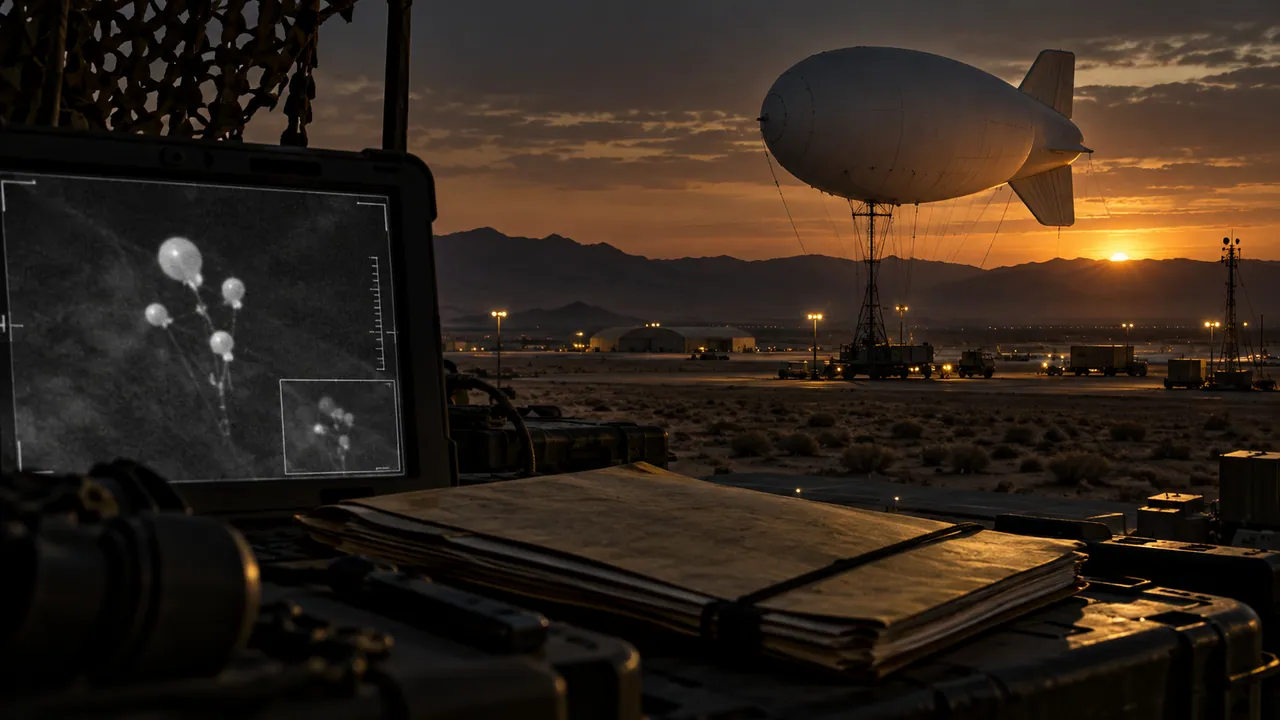
Government archive review · September 30, 2026
The Al Taqaddum case offers more than a short viral silhouette. AARO's September 8, 2025 case report describes a 17-minute, 30-second infrared observation from an aerostat over the Iraqi air base on October 23, 2017. The office assessed with high confidence that the object was consistent with a cluster of inflated and partly inflated balloons and displayed no anomalous capabilities. This is a review of an existing assessment, not a new release.
The evidence behind the assessment
AARO lists full-motion video, metadata, line-of-sight reconstruction and weather analysis as inputs. Its synopsis places the object at an assessed 850–2,200 feet and 4–14 mph. Those are analytical estimates, not measurements independently reproduced by UFOsoldier. The report's conclusion depends on the combined record, rather than the object's unusual outline alone.
The official DVIDS video entry corroborates the published agency position: it describes balloon-like morphology, pixel examination and use of the aerostat's geolocation to assess motion. It is another government publication of the same investigation, not an independent investigation reaching the same result.
Keep the public metadata differences visible
DVIDS lists a runtime of 17:27 and a date-taken field of October 1, 2017; the case report gives 17:30 and October 23. The DVIDS description itself says only October 2017. These small discrepancies deserve preservation in research notes. They do not, by themselves, overturn the balloon assessment or establish that footage was manipulated. Resolving them would require an explanation of the catalog fields and the relationship between the analyzed recording and the published file.
What would strengthen an outside review
A useful replication package would connect the released video to the original timestamps, platform position, wind inputs and reconstruction assumptions. That would let other analysts test whether the same inputs produce the same motion estimates. NASA's independent UAP study likewise emphasizes reproducible analysis and sufficiently informative data. It supplies methodological context here, not a separate verdict on Al Taqaddum.
The public record supports reporting AARO's stated high-confidence conclusion. It does not justify treating every detail of a reposted clip or its catalog entry as a fully resolved measurement.
Hero image: original AI-generated editorial illustration. It is conceptual, not evidence, a sensor image, or a reconstruction of the reported event.