
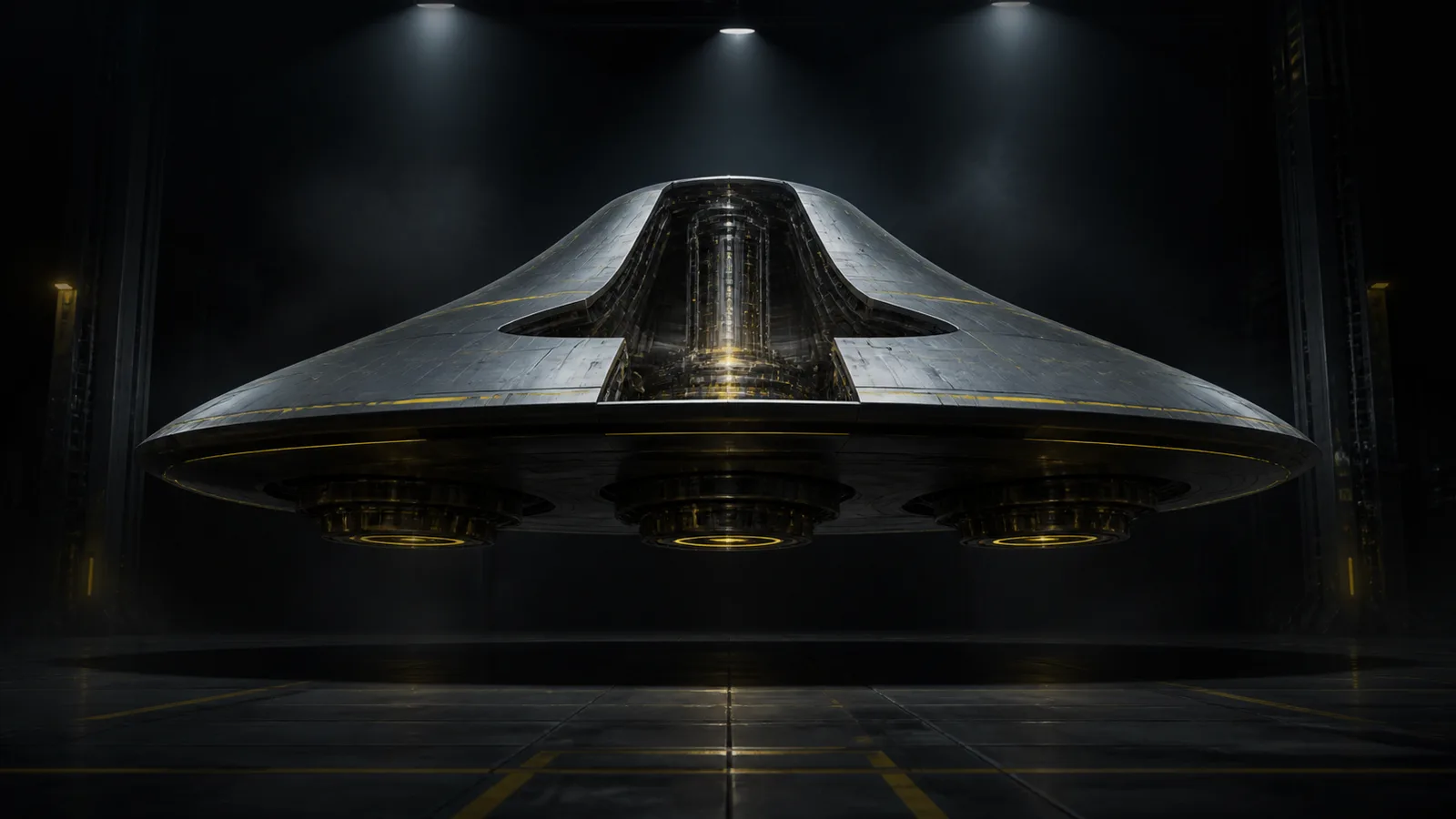
ALIEN REPRODUCTION VEHICLES — CLAIMS VS. EVIDENCE
“Alien Reproduction Vehicle,” usually shortened to ARV, is a term used in UFO literature for an alleged human-made craft built by studying or reproducing recovered non-human technology. The best-known version of the story centers on illustrator and aerospace designer Mark McCandlish and a claimed classified display of three disc-shaped vehicles at Norton Air Force Base in the late 1980s.
The ARV account has become one of the most visually recognizable reverse-engineering stories in modern UFO culture. It is also a useful case study in the difference between detailed testimony and independently verifiable evidence.
The origin of the “Flux Liner” story
McCandlish said a colleague—often identified publicly as aerospace illustrator Brad Sorensen—described being taken to a restricted presentation at Norton Air Force Base around 1988. According to the account, three hovering, saucer-shaped vehicles were displayed inside a hangar. One reportedly bore markings that led witnesses to believe it had been manufactured by a U.S. aerospace contractor.
McCandlish did not claim to have attended the event himself. His illustrations and technical descriptions were reconstructed from what he said Sorensen told him. That distinction is fundamental: the most widely circulated ARV image is an artist’s reconstruction based on a secondhand account, not a verified photograph or engineering drawing.
The alleged craft became known as the Flux Liner. Descriptions typically include a flattened disc or bell-shaped body, a central column, large capacitor-like plates and three units around the lower surface described as “electrogravitic amplifiers.” The proposed operation involves extremely high voltage, rotating electromagnetic fields and a claimed reduction or manipulation of gravitational or inertial effects.
Why the description attracts attention
The story combines several themes that have appeared repeatedly in UAP claims: deeply compartmented programs, private aerospace contractors, unconventional propulsion, restricted military facilities and technology allegedly derived from recovered craft.
It also offers unusually specific visual and mechanical details. Specificity can make testimony valuable for investigation because it produces claims that could, in principle, be checked. But specificity alone does not establish authenticity. A technically elaborate narrative can still be mistaken, embellished, misunderstood or fabricated.
What can be verified
- Mark McCandlish publicly presented the ARV account and his Flux Liner illustration.
- The Disclosure Project placed this and other reverse-engineering allegations into a public testimony campaign.
- Patents and speculative engineering proposals exist for triangular craft, high-voltage propulsion and field-effect concepts.
- Official reviews acknowledge that the U.S. government has investigated unusual sightings and has operated highly classified aerospace programs.
View the 2001 Disclosure Project National Press Club event
Review an often-cited triangular spacecraft patent
A patent proves that a concept was submitted and described; it does not prove that the device was built, that it works, or that it originated from non-human technology.
What remains unverified
No publicly authenticated ARV vehicle has been produced for independent examination. No confirmed program records, procurement documents, test data, materials analysis, native imagery or engineering package has established that the alleged Norton display occurred as described.
The central story is also one step removed from the alleged event: McCandlish relayed another person’s reported experience. Without direct, independently testable evidence, the claim cannot be elevated to the same confidence level as an authenticated government document or instrumented event.
Official counter-context
AARO’s historical review states that it found no empirical evidence that the U.S. government or private companies have successfully reverse-engineered extraterrestrial technology. The report also argues that some extraordinary accounts grew around genuine classified programs that were concealed from observers.
Read AARO’s Historical Record Report, Volume 1
AARO’s conclusion is not proof that every allegation is false. It is the official finding that must be weighed against witness claims. Critics have challenged the scope, sourcing and completeness of the review, but those criticisms do not by themselves verify the ARV story.
UFOSoldier assessment
The ARV narrative deserves preservation as a historically influential reverse-engineering allegation. Its detailed design claims provide potential investigative leads, especially if corroborating witnesses or authentic program records emerge.
At present, however, the public evidence supports only a cautious conclusion: the ARV is a documented claim, not a documented vehicle. The decisive evidence would be authenticated program records, independently examined material, original imagery with provenance, measurable flight data, or multiple firsthand witnesses whose accounts can be independently corroborated.
Until that evidence appears, the Flux Liner should be treated as an important part of UAP disclosure history—not as established proof of operational alien-derived technology.