
UAP SCIENCE — SEPTEMBER 26, 2026
The Galileo Project has published a September 24 manuscript describing distance measurements from three infrared-camera sites around Las Vegas. It is marked submitted to Sensors; the copy reviewed does not establish acceptance or completed peer review. The result is an early test of a measurement system, with no extraordinary object established.
Measure range before interpreting motion
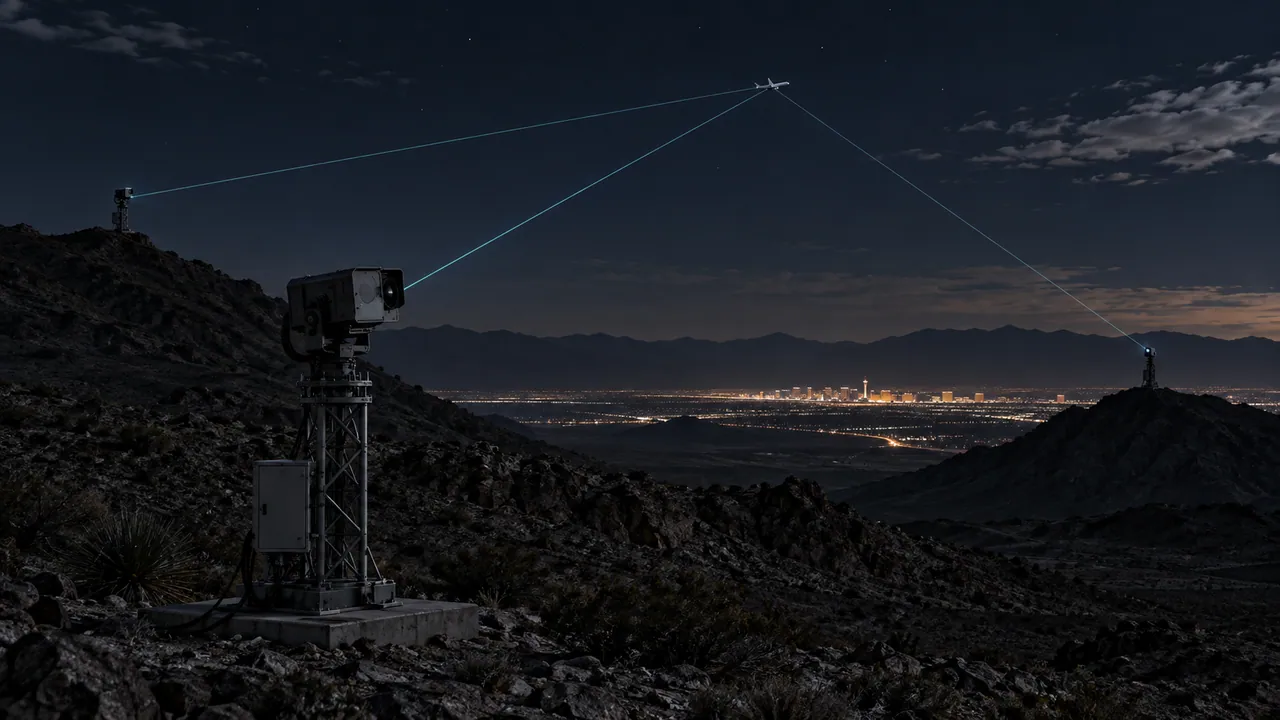
The study combines simultaneous sightlines from separated cameras and checks reconstructed aircraft positions against ADS-B broadcasts. For May 24–30 observations, the abstract reports distance recovery within 5% for 99% of aircraft solved using three sites, compared with 83% using a single site pair. This is a reported validation result, not an independent replication.
In his accompanying explanation, Avi Loeb emphasizes why range matters: an object nearby can cross an image rapidly while moving modestly through space. The same angular movement at a much greater distance implies a different physical speed. A striking visual track alone cannot choose between those geometries.
What the first population contains
Loeb describes 365 longer tracks solved from all three sites: 284 identified aircraft, 17 unidentified tracks with aircraft-like properties, and 64 slower detections interpreted on inspection as small clouds. An unmatched aircraft-like track is not automatically an anomalous vehicle. The article reports no object beyond ordinary natural or human-made populations in that analyzed week.
One detail deserves attention when quoting accuracy: Loeb's commentary describes every three-site aircraft distance as within 5%, while the manuscript abstract says 99%. Those formulations differ. This article uses the abstract's more conservative figure and leaves reconciliation to the authors.
The broader scientific test
NASA's independent UAP study explains that missing calibration and contextual metadata often prevent meaningful conclusions about size and motion. It calls for measurements capable of testing and rejecting explanations. That provides independent methodological context for triangulation, though NASA's report does not validate this new experiment.
UFOsoldier's assessment is that range recovery is a useful capability to demonstrate before claiming exceptional performance. The next test is whether other researchers can reproduce the results and evaluate sensitivity, association errors and uncertainty. A short observation window can characterize that sample; it cannot establish what every sky contains.
Sources and reading
- An Assessment of the Triangulation Capabilities of a Multi-Site All-Sky Infrared Camera Array — Galileo Project / Harvard-Smithsonian Center for Astrophysics.
- First Triangulation Results in Search for UAP by the Galileo Project Observatories — Avi Loeb / Medium.
- NASA UAP Independent Study Team Final Report — NASA.
Hero image: original AI-generated conceptual illustration. It does not depict evidence, a verified event, or an authenticated document.