A newly posted NUFORC pilot report offers a concrete investigation request: reconstruct historical satellite positions and illumination before deciding what a striking sequence of lights represents. The submission concerns a Boeing 767 flight toward Louisville early on September 5 UTC and was posted September 7.
A witness account with explicit limits
The reporting pilot describes recurring bright points and a separate sequence that appeared to stop and diverge into two lights. The account gives no measured range or physical speed. Its supporting document expressly distinguishes the appearance of splitting from evidence that a single object physically divided.
The witness considers satellite flaring a strong candidate for the recurring lights, while asking for a satellite-by-satellite test of the unusual sequence. The PDF separates recollection from a later flight-track and sky reconstruction. Its unresolved classification is the submitting report's assessment, not an independent finding by this publication.
Why the proposed test is credible
Separate research provides a practical basis for doing that work. Anthony Mallama and Richard Cole's study of extreme Starlink flaring explains how reflected sunlight can make satellites unusually bright and applies the model to a different aviation report. It does not identify this Kentucky observation.
A second study, by Douglas Buettner and colleagues, reconstructed a 2022 aviation sighting using satellite orbital elements and aircraft tracking data. The method joins the moving observer's position to the predicted sky. Both papers support testing an ordinary explanation quantitatively; neither can be used as a blanket verdict on every report of lights.
The missing result
Editorial assessment: A useful reconstruction would publish its orbital inputs, timing uncertainty, observer trajectory and illumination assumptions. It should test whether several sources brightening and fading could reproduce the reported apparent continuity, while considering optical and perceptual effects. A failure to find a match would need to be assessed against the completeness of those inputs.
The source package is valuable because it invites correction rather than assigning an origin. The correct next step is the requested comparison. Until that work is available, neither an extraordinary maneuver nor a definitive satellite identification follows from the account alone.
Source record
- NUFORC report 200728 — NUFORC
- Airborne unidentified lights technical submission — NUFORC / submitting witness
- Extreme Flaring of Starlink Satellites — Mallama and Cole / arXiv
- Starlink misidentification case study in commercial aviation — Buettner and colleagues / arXiv
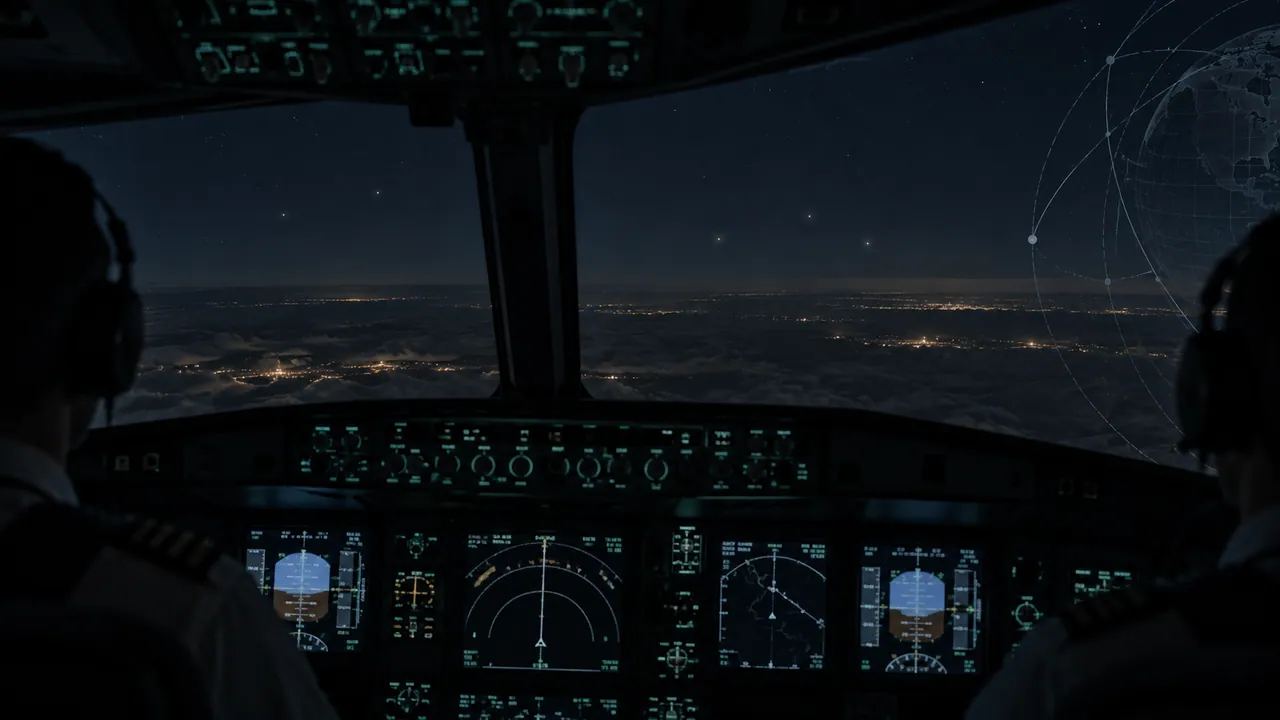
Hero image: original AI-generated editorial illustration; not documentary evidence.