
FIELD INTEL // SEPTEMBER 10, 2026
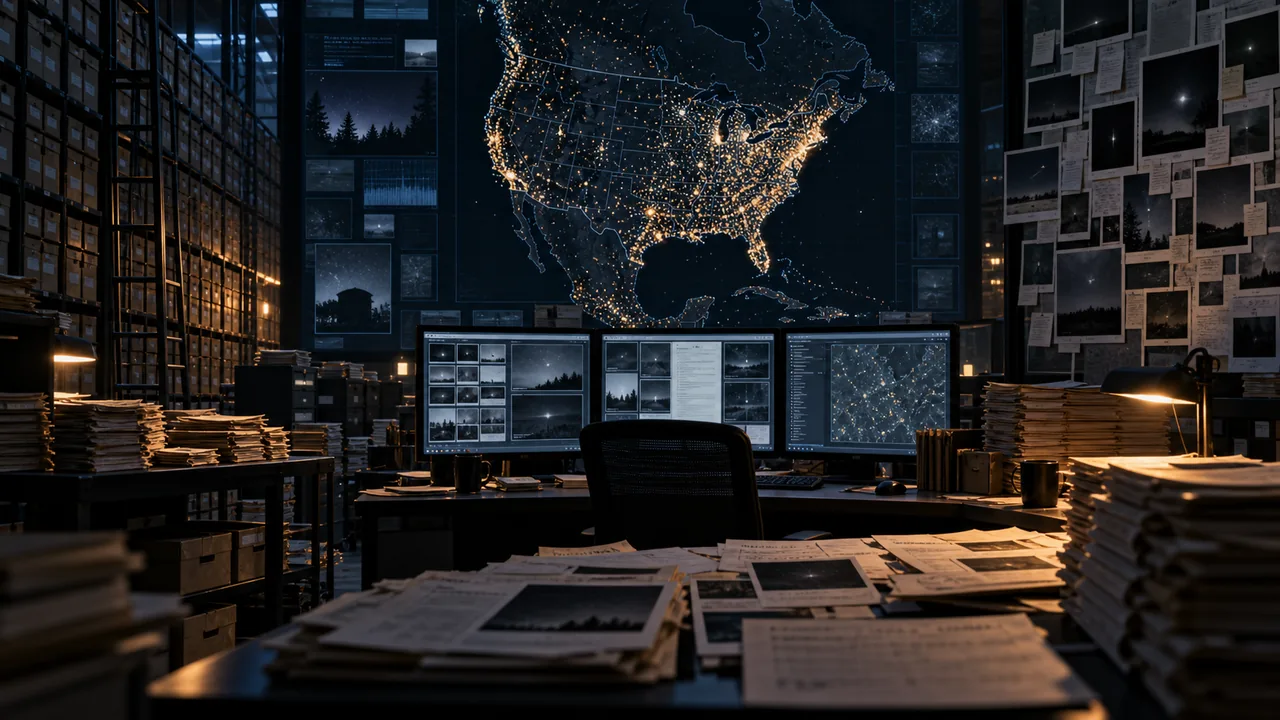
The National UFO Reporting Center says it received its 200,000th sighting submission in August, a milestone reached across more than five decades of public reporting. The number is important because it represents a large, searchable record of what people believed they saw, when they saw it and how they described it. It does not mean that investigators have confirmed 200,000 unknown craft.
What the archive actually contains
NUFORC accepts reports from the public and publishes structured fields such as date, location, duration, shape and a witness narrative. Its posted-date index shows the archive continuing to grow in frequent batches, including new entries in September. That continuity makes the database useful for studying reporting behavior, recurring descriptions, geographic patterns and the effects of major news events.
The archive is also heterogeneous. A short light in the sky, a pilot report, a close-range claim and an image submitted years after an event can all enter the same broad collection. Those reports do not arrive with a common sensor package, calibrated camera, verified clock or independent witness. Some include photographs or video; many rely on memory and estimation.
Scale improves some questions and worsens others
Two hundred thousand records can reveal population-level patterns that a single dramatic case cannot. Researchers can test whether reports cluster around airports, military training routes, astronomical events, satellite deployments or media attention. They can examine how descriptions change as drones and consumer cameras become common. They can also identify repeated witnesses, copied narratives and reporting bursts.
But a larger database does not automatically raise the evidentiary quality of each row. Selection bias remains substantial: people choose whether to report, may wait before filing and may use the same cultural vocabulary to describe different objects. Location and time can be approximate. A count of submissions therefore measures reporting activity first; it measures unexplained physical events only after case-by-case screening.
The evidence-first way to use it
- Preserve the original submission and every later edit.
- Separate event time from report time.
- Retain raw media and metadata when available.
- Check aircraft, satellite, weather and astronomical data against the stated time and place.
- Record why a case was explained, unresolved or excluded rather than treating every entry alike.
Independent reporting on regional NUFORC statistics has already shown why denominators and local context matter. Per-capita comparisons can be influenced by population, access to reporting channels, local history and proximity to airports or military facilities. Those are variables to model, not reasons to discard the archive.
Bottom line
NUFORC's milestone is best understood as infrastructure: a very large public witness archive that can support hypothesis testing when paired with external data. It documents 200,000 reports. It does not, by itself, establish 200,000 anomalous objects, extraterrestrial vehicles or government-confirmed incidents. The scientific opportunity is to make the archive more reproducible, more transparent and easier to cross-check.