
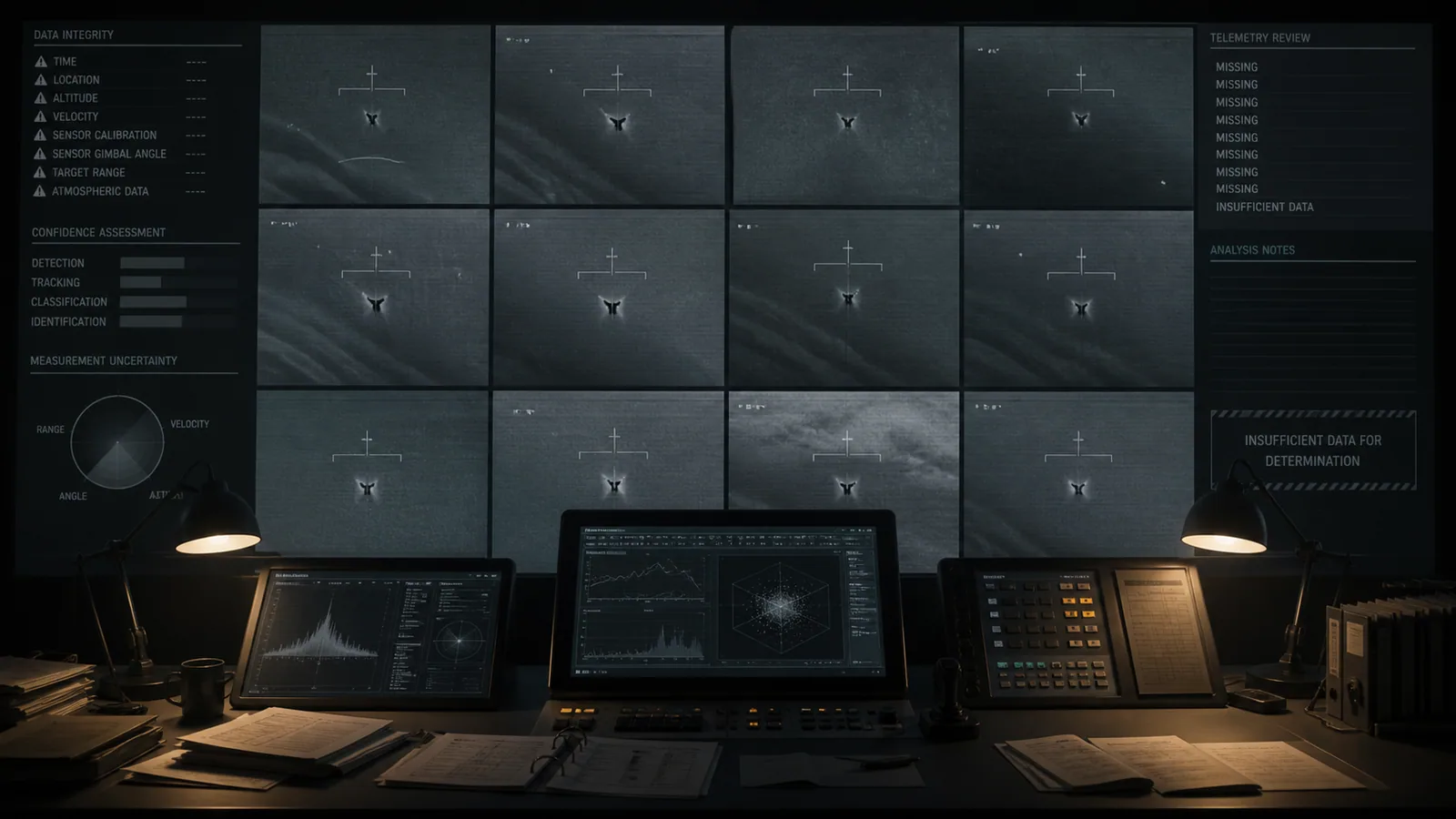
The most important result from the latest scientific pass over the Pentagon’s public UAP footage is not a spectacular velocity. It is a limit: the released videos do not contain enough information to calculate one reliably.
What the researchers tested
Jacob Haqq-Misra and Ravi Kopparapu examined 112 sensor videos released through the government’s PURSUE program. Recovering true velocity from a moving camera requires several linked measurements, including platform motion, range to the target, viewing geometry, sensor calibration and timing. According to their analysis, no public clip supplies the full set.
Why apparent motion is not enough
A point can race across a display because the object is fast, because the camera is moving, because the sensor is panning, or because a nearby object produces strong parallax. Without range and platform telemetry, those possibilities cannot be separated quantitatively. A visually dramatic track is therefore an observation to investigate, not a speed measurement.
What this does—and does not—mean
The study does not resolve the 112 events and does not prove that every object is ordinary. It shows that the public evidence package is incomplete for one of the field’s central claims: extraordinary performance. That is a meaningful scientific finding because it identifies the exact data future releases must include.
The field-intel takeaway
More clips alone will not settle the UAP question. Useful disclosure means synchronized native video, range, aircraft position and attitude, sensor metadata, weather, and corroborating radar or optical observations. Until those elements are available, speed claims based only on pixels should be labeled indeterminate.