SCIENCE WATCH // SEPTEMBER 7, 2026
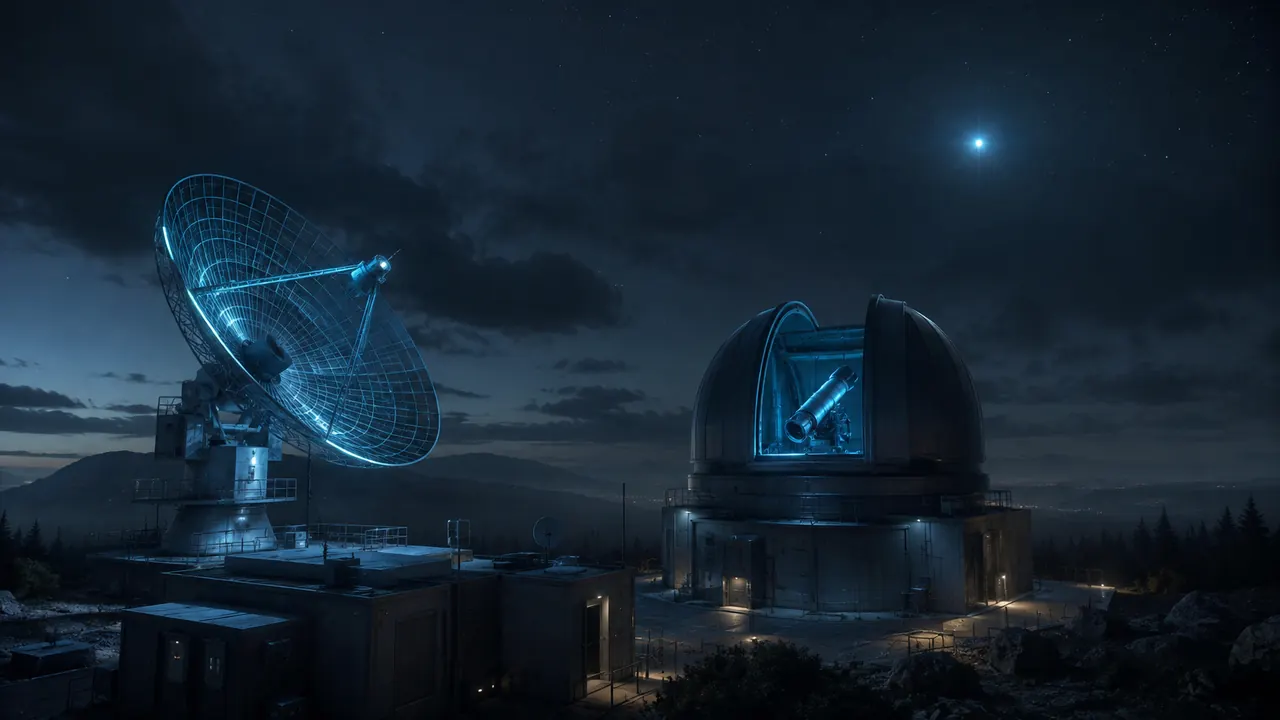
Avi Loeb has proposed a purpose-built observatory for reports commonly described as UAP orbs. The concept combines a radar system that searches a large fraction of the sky with a fast meter-class telescope that slews to the radar coordinates. A spectrograph would then measure the light rather than relying only on color descriptions from witnesses or compressed video.
The useful idea is sensor fusion
Most public UAP videos do not provide range. Without range, angular motion cannot be converted reliably into true speed or size. Radar can supply distance and radial velocity; a calibrated telescope can provide angular position, morphology, photometry and spectra. When the instruments share a clock and coordinate system, the same event can be tested across independent measurement channels.
Loeb argues that arcsecond-scale optical resolution could reveal centimeter-scale detail at a few kilometers under favorable conditions. That is an engineering target, not a guarantee. Atmospheric seeing, focus, tracking error, target brightness, exposure time and motion blur all determine the real resolving power of a field system.
What a credible build must publish
- Radar frequency, coverage, false-alarm filters and range uncertainties
- Telescope aperture, field of view, slew time and tracking limits
- Absolute time synchronization and calibration records
- Raw data, processing code and a complete event-selection log
- Checks against aircraft, drones, balloons, satellites, meteors and ball lightning
The Galileo Project's earlier peer-reviewed observatory design already emphasizes multimodal collection, including wide-field cameras, narrow-field instruments, passive radar, radio-frequency monitoring, acoustics and environmental sensors. The new orb-imager concept is best viewed as a targeted extension of that approach.
The classification trap
An instrument optimized around the word orb must not assume that every compact light is one physical class. Out-of-focus stars, aircraft lights, sensor saturation, reflections, balloons and atmospheric emission can all produce round images. The system should classify by measured behavior and uncertainty, not by appearance alone.
Assessment
Promising instrumentation concept, unproven performance. The proposal does not establish that reported orbs are exotic. Its value is that it defines measurements capable of proving many ordinary explanations—and of preserving a genuinely anomalous residual if one survives calibrated, multisensor scrutiny.