
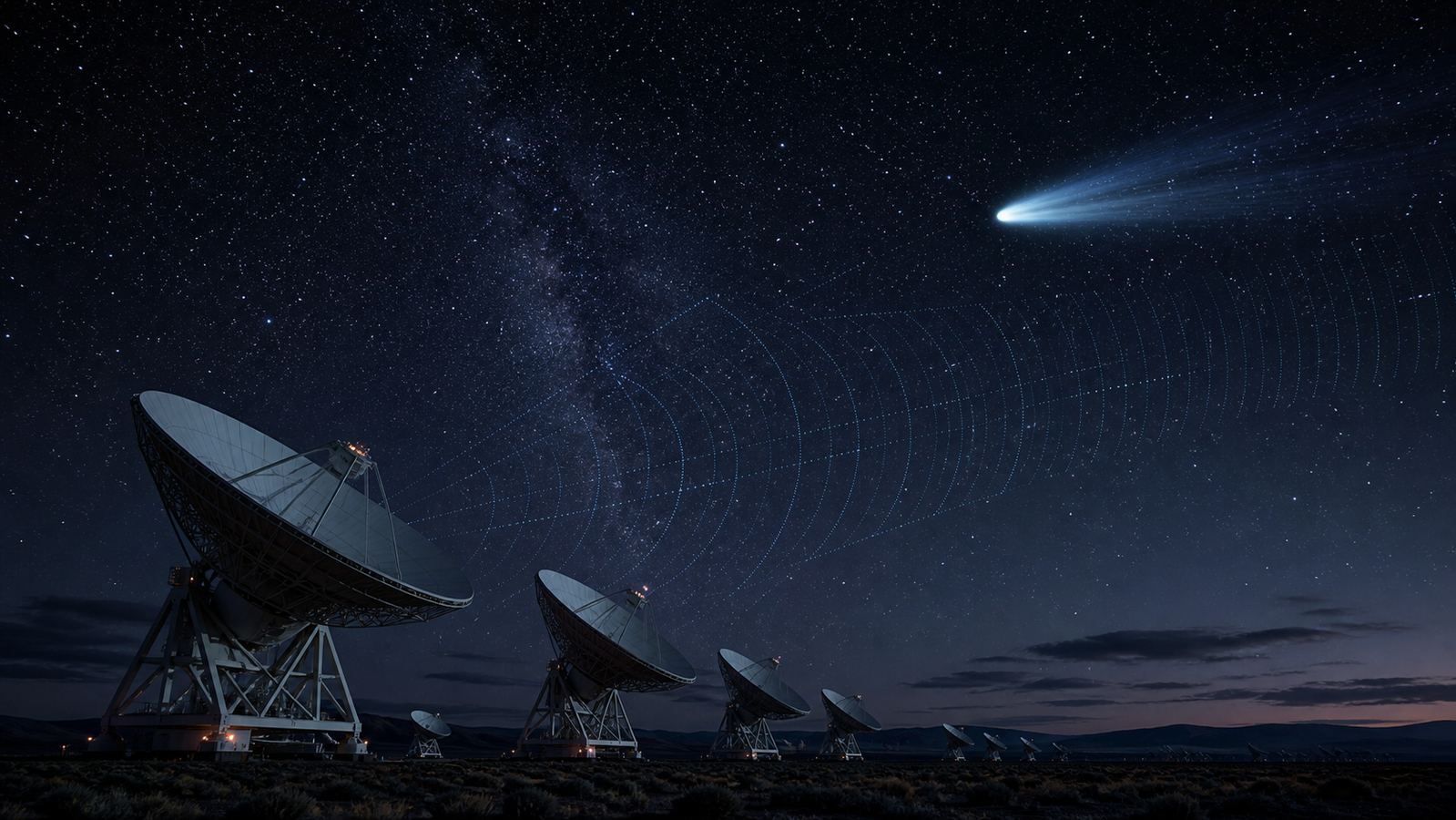
Bottom line: scientists pointed the Allen Telescope Array at interstellar visitor 3I/ATLAS and found no evidence of a radio transmitter. The negative result is scientifically useful because it turns a popular alien-spacecraft question into a measured constraint.
A rapid-response test
The SETI Institute reports that observations began less than a day after the object’s announcement. The array collected more than seven hours of data across 1–9 GHz, searching for narrowband radio signals that could indicate technology.
The pipeline began with approximately 74 million detected signals. Filtering for terrestrial interference and motion consistent with 3I/ATLAS reduced that enormous set to roughly 200 candidates. Follow-up analysis traced every remaining candidate to technology on Earth or in Earth orbit.
What “nothing found” actually constrains
The team reports that the observations rule out transmitters stronger than roughly 10–110 watts on or near 3I/ATLAS over the frequencies examined. That does not rule out every imaginable technology: a transmitter could be weaker, intermittent, directional, outside the observed band, or absent entirely. It does rule out a defined class of signals at a stated sensitivity.

Why test a likely natural comet?
Interstellar objects are rare samples from other planetary systems. Astronomical observations strongly indicate natural cometary composition and behavior for 3I/ATLAS. Still, a fast, reproducible radio check is relatively inexpensive and exercises the systems needed for future genuinely unusual visitors.
Evidence-first assessment
Verified: the telescope, frequency range, observing duration, filtering pipeline, negative result, and power limits are reported by the research team; the work is linked to DOI 10.3847/1538-3881/ae6651. Not supported: claims that 3I/ATLAS transmitted an artificial signal or is an alien craft. The useful story is the method: observe quickly, publish sensitivity limits, identify human interference, and say clearly when the candidate fails.