Research-programme review · October 2, 2026. The Society for UAP Studies' public 2026–2027 research agenda includes a working group intended to define stronger standards of evidence for UAP research. Its stated deliverable is a white paper. The important question is how the proposed framework would earn scientific acceptance through criticism, comparison and use.
What the Society is proposing
The Society's research page names Gretchen Stahlman and Laura Dominé as principals of the Standards of Evidence initiative. It describes an interdisciplinary effort to connect observations with credible inferences and says it is modeled on astrobiology's biosignature-evidence work. The page identifies an August 2026 summit as an organizing and partnership opportunity.
That page is a programme statement, not a published set of completed standards or a validation study. Our review found an announced aim and leadership structure there; it does not establish that a white paper has been completed or adopted. This article reviews the standing agenda rather than reporting a newly announced discovery.
The precedent includes a caution
NASA describes its Confidence of Life Detection scale as a proof-of-concept framework for communicating progressively stronger evidence. It was designed to start a scientific conversation, not to turn an ambiguous signal into a yes-or-no announcement.
The National Academies' independent 2022 review supported a common language for assessing and communicating potential biosignatures, while noting that universal adoption of a single framework would be difficult. It also warned that verification structures could obstruct open science, and emphasized comparison among multiple working hypotheses.
Those sources corroborate the intellectual precedent invoked by the Society. They do not endorse this UAP initiative, certify its methods, or establish an equivalence between biosignatures and unidentified aerial observations.
How a useful framework could be evaluated
Our editorial assessment is that a practical UAP framework should make investigators' reasoning easier to reproduce. It could ask whether an instrument was calibrated, whether time and location are preserved, how custody and transformations are documented, and which alternative explanations were actually tested. It should distinguish absent evidence from evidence that contradicts a proposed explanation.
For a distant light, for example, a reliable record of the light's appearance is not automatically a measurement of its distance or acceleration. A classification system should show those missing steps rather than hide them inside a single confidence label.
The next useful milestone would be an accessible draft, worked examples, and a transparent route for disagreement and revision. Until then, the programme is a concrete proposal for better research practice, with its scientific value still to be demonstrated in public.
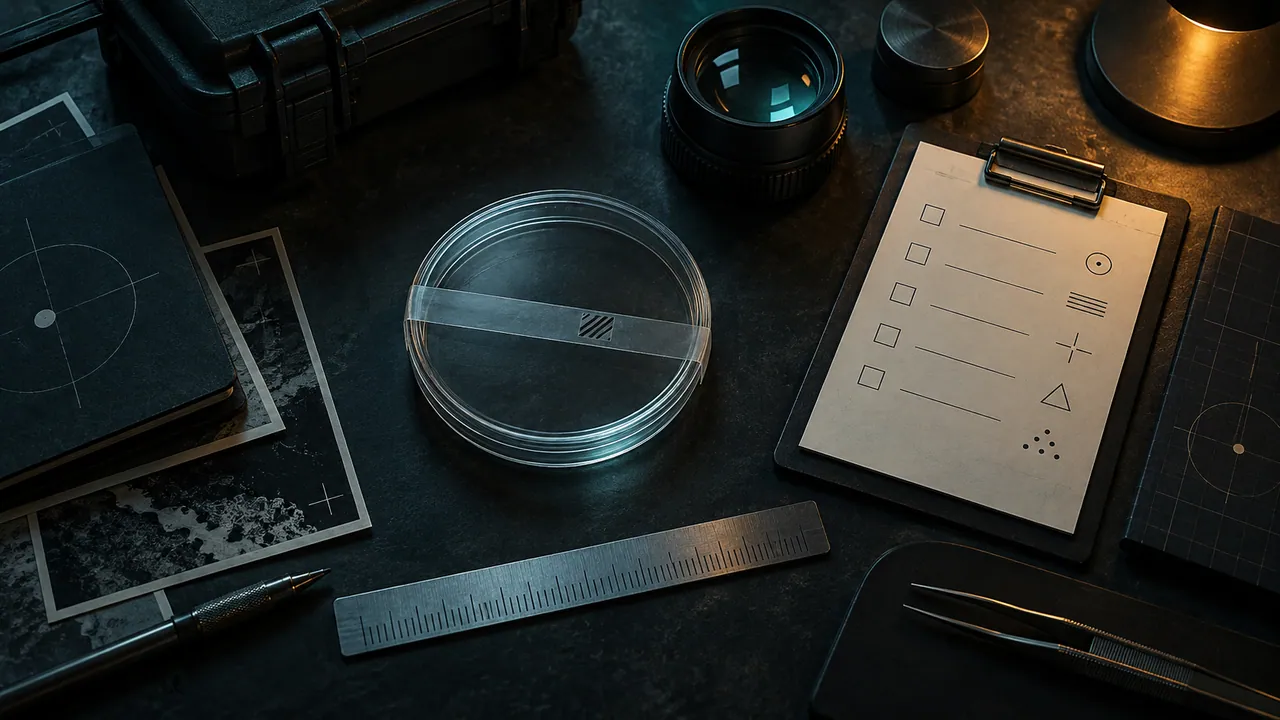
Hero image: original AI-generated editorial illustration; not a photograph of an event, document, or recovered object.