
SCIENCE WATCH // AUGUST 27, 2026
A preprint by Shaun Fell and Abraham Loeb asks a useful question about an extraordinary idea: if a spacetime bubble moved through Earth’s atmosphere, what would observers actually detect? Their simulations describe interactions between a hypothetical warp geometry and air, including intense radiation at high velocities.
The paper does not report a warp drive. It does not identify a UAP video as a warp bubble. It models consequences that would follow if a specified physical scenario existed. That distinction separates a scientific hypothesis from a social-media conclusion.
The predicted signature
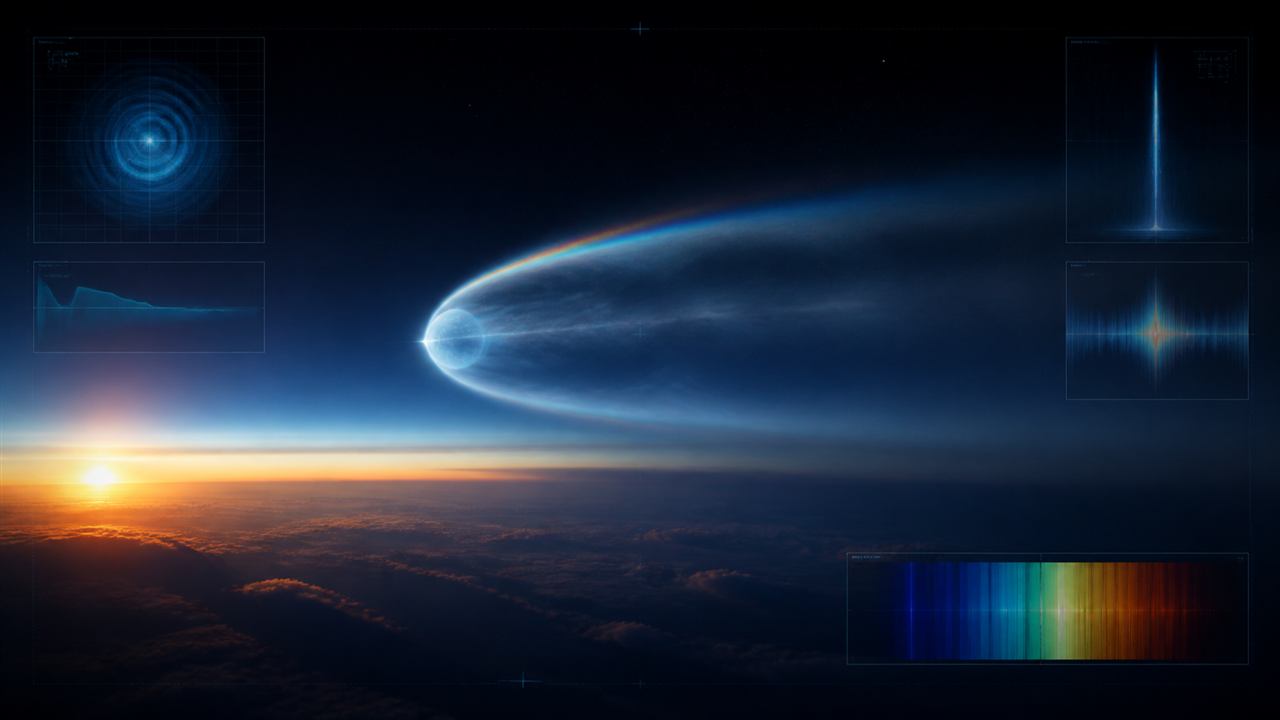
The authors calculate that an aircraft-scale bubble moving through the atmosphere at relativistic speed would not be visually subtle. The interaction could generate enormous luminosity; above roughly one-tenth the speed of light, the paper predicts a distinctive, brilliant atmospheric signature. That is useful because it gives investigators something to seek—and something whose absence can count against the hypothesis.
- 🛸 Time-resolved optical brightness across multiple wavelengths.
- 🛸 Spectral lines or continuum emission consistent with heated and ionized air.
- 🛸 A trajectory and duration consistent across separated sensors.
- 🛸 Energy deposition, shock, acoustic, or other environmental effects.
- 🛸 Range data sufficient to convert angular motion into true speed.
Why ordinary UAP video is insufficient
Most public UAP clips lack range, calibrated radiometry, original metadata, and synchronized measurements. A luminous dot crossing a compressed frame cannot be assigned a physical speed from apparent motion alone. Without distance, the same angular track can describe a nearby slow object or a distant fast one.
That limitation is especially important when exotic theories are attached to low-information imagery. The theory may be mathematically interesting while the observation remains too weak to test it.
A productive standard
The best use of the preprint is prospective. Sensors can be configured to record the wavelengths, timing, geometry, and environmental channels needed to compare a future event with the model. If the predicted radiative signature is absent where the model says it should be overwhelming, investigators should reduce confidence in that explanation.
Assessment: The paper is a legitimate theoretical calculation posted as a preprint and should be evaluated through peer review and independent modeling. It makes no evidentiary case that known UAP are warp drives. Its contribution is a testable prediction, which is exactly how an extraordinary hypothesis should enter the discussion.